
Dr. Amy Adams of Knight Piésold Canada Highlights Integrated Stability Analysis for Staged Embankment Design at 2026 CDA Annual Conference
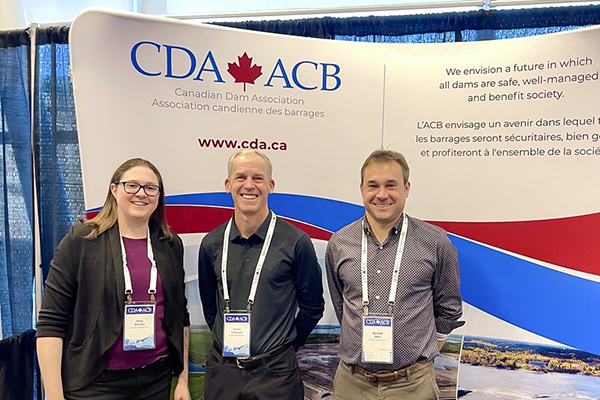
October 30, 2026, Vancouver, BC, Canada – Dr. Amy Adams, Senior Engineer at Knight Piésold Canada, presented an integrated approach to staged embankment design at the 2026 Canadian Dam Association (CDA) Annual Conference & Trade Show. Dr. Jaime Cathcart, Specialist Hydrotechnical Engineer, and Benoit Otis, Specialist Engineer, also represented Knight Piésold Canada at the conference.
Held October 25–28, 2026, in Halifax, Nova Scotia, the conference brought together more than 700 dam operators, regulators, consultants, suppliers, and academics for technical sessions, interactive workshops, networking opportunities, and technical tours. The theme, “Tides of Change: Adapting Dams for a Dynamic Future,” called on the dam engineering community to respond to evolving challenges and opportunities, including climate adaptation, aging infrastructure, emerging technologies, and regulatory shifts.
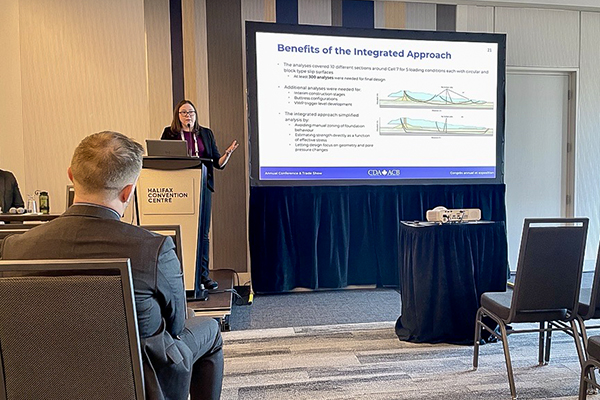
In Session 1D1, Dr. Adams presented “Integrated Approach to Rapidly Iterate Through LEA Stability Analyses for Design of Staged Construction Over Silty Clay Soils.” The paper was co-authored by Jessica Breault, Senior Engineer, and Dr. Reagan McIsaac, Specialist Engineer, both of Knight Piésold Canada, and by Gabriel Ploudre, Mill Manager, and Dominic Girard, Tailings Facility Coordinator, both of Orezone Québec Inc., Casa Berardi Mine.
Dr. Adams introduced an integrated methodology using Limit Equilibrium Analysis (LEA) to evaluate the stability of large embankments constructed over silty clay foundations, where soil behaviour can range from drained to undrained. Based on well-known soil mechanics, the approach combines drained and undrained strengths in a single soil strength model that accounts for shear-induced pore pressures.
She explained how this simplifies stability analysis by allowing designers to focus on changes in embankment geometry and pore pressure, rather than subdividing silty clay foundations into different behavioural and strength zones.
Using the embankment raise at the Casa Berardi Mine in western Quebec as a case history, Dr. Adams illustrated how the integrated method supported the initial design, the development of factor of safety-based trigger levels, and rapid assessments of proposed construction schedule changes that would affect overall stability.
The approach can be applied to tailings dams, water dams, mine waste storage piles, and other civil infrastructure embankments built over silty clay foundations. By integrating design, construction planning, and monitoring, Knight Piésold helps clients make informed decisions, manage construction risks, and respond to changing project conditions and schedules.
Sharing this work at the CDA conference contributed to the exchange of practical approaches to dam safety in an evolving industry. Knight Piésold continues to help clients navigate changing industry requirements and looks forward to collaborating with clients and the industry to turn shared knowledge into practical solutions for safer, more resilient dams.